The Oak and the Larch: A Forest History of Russia and Its Empires
- By Sophie Pinkham
- W.W. Norton & Company
- 304 pp.
- Reviewed by Jonas Vaicikonis
- February 3, 2026
How the country’s relationship to its trees shaped its place in the world.
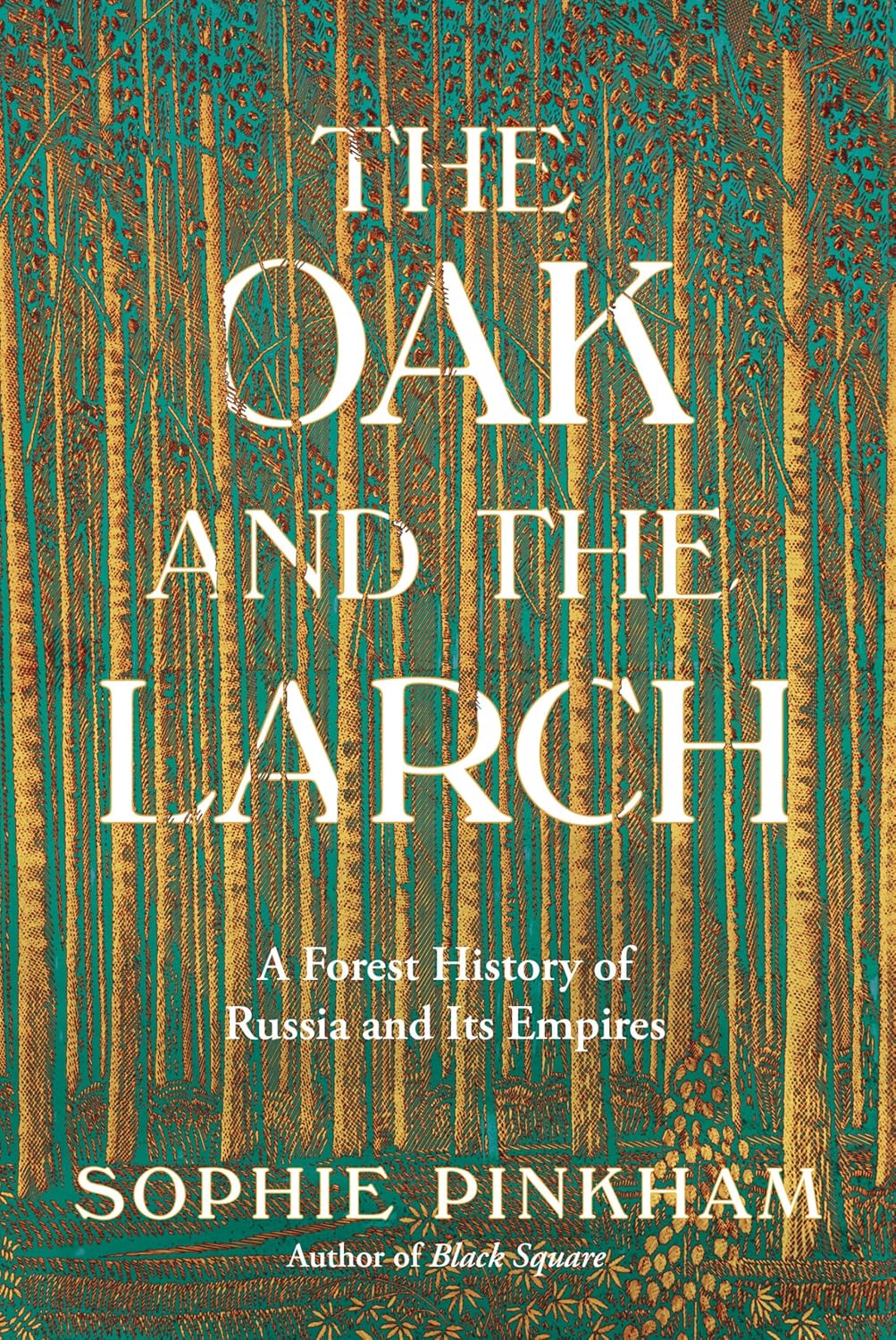
What often gets lost in the familiar version of Russian history as a long procession of tsars, wars, revolutions, and ideologies is the landscape itself. Cornell professor and New York Review of Books contributor Sophie Pinkham’s thoughtful new book, The Oak and the Larch, offers a fresh way to understand Russian history: through its forests.
Her title sets up the big idea right away. The deciduous oak, which thrives in “European Russia,” evokes more than a thousand years of connection to the rest of Europe and the West. The coniferous larch, which grows across Siberia, gestures toward Russia’s vastness and its ties to Asia. Pinkham uses this botanical contrast as a narrative compass. Instead of marching readers through a parade of battles, rulers, and dates, she invites us to wander with her through folktales, literature, and film toward a deeper sense of how the natural world shaped Russian identity across the landmass of Eurasia.
This approach feels especially timely. Some readers today are distancing themselves from Russian culture because of Vladimir Putin’s war on Ukraine and are calling to decolonize the study of the region. Pinkham doesn’t shy away from Russia’s imperialism, Soviet repression, or contemporary atrocities. But she also refuses to discard the art, literature, and human complexity that emerged in these same spaces. She writes with clear eyes and an open, steady hand.
At first glance, one might think Pinkham is attempting something similar to Bathsheba Demuth’s Floating Coast: An Environmental History of the Bering Strait, which tells the history of the region through the lens of its many habitats. But Pinkham’s method is more literary and intimate. She structures the book in 15 short, vivid chapters that read almost like a series of polished magazine essays. The result is deeply accessible: Newcomers to the region will find themselves swept along by memorable vignettes, while longtime Russia-watchers will discover angles and connections rarely emphasized in traditional histories dominated by Peter the Great, Stalin, or Putin.
Some of her most memorable sections are her close readings of the titans of Russian literature, such as Pushkin, Chekhov, and others, which she reads against the forests that shaped them. Her portrait of Tolstoy particularly stands out. As a young nobleman, he cut and sold timber from his estate to pay off gambling debts, and he also took part in the deforestation of the Caucasus during military campaigns as a young officer.
The guilt shadowed him for years. When he finally earned enough money from War and Peace, he bought 50,000 birch and fir seedlings to reforest his land. Pinkham writes:
“Most writers merely turn trees into books; he closed the loop, turning his novel into a forest.”
Later chapters examine the enduring myth of the Russian Far East as a place of wild freedom — an escape from state control — and the simultaneous urge to conquer, exploit, and “civilize” it. Pinkham recounts the story of Russian explorer Vladimir Arsenyev and his Indigenous guide Dersu Uzala, figures known to many people with ties to the Soviet Union but less familiar to Western audiences.
Their relationship, rendered in Arsenyev’s 1926 memoir, depicts Dersu as a man so at home in the wilderness that he can persuade a tiger to back away simply through respectful presence. Yet as modernization advances, Dersu’s world shrinks. Illness forces him to a city, where he suddenly finds himself criminalized for cutting firewood in a public park. He returns to the forest despite failing eyesight because it is the only place he can live as himself. It’s both a romantic story and a colonial one, and Pinkham handles each with clarity and care. As she writes in an earlier chapter:
“Russia’s imperial ambitions were punctuated by the sound of forests falling in vain.”
If there’s a drawback to the book, it’s that the author’s swift movement across centuries sometimes leaves the reader wishing to linger longer in certain eras. But that pacing is also part of its charm: The book piques curiosity without overwhelming the reader, and the short chapters lend themselves to being enjoyed in one sitting.
The Oak and the Larch invites us to look at Russia not only as an empire, a conflict zone, or a geopolitical puzzle, but also as a landscape that shaped the people who shaped history. For readers who remain fascinated by Russia, while fully aware of the suffering its state has inflicted, Pinkham’s book offers something rare: perspective, nuance, and a quiet kind of wonder.
Jonas Vaicikonis has long been fascinated by Russian history and culture. He continues to read widely about Russia, drawn as much to its contradictions as to its beauty. He hopes its forests continue to be a source of shelter, sustenance, and awe.